In the rapidly evolving global food landscape, the demand for high-protein, shelf-stable, and ethically sourced seafood has never been higher. For brand owners, retailers, and entrepreneurs, the most efficient route to capturing this market is through OEM canned fish production (Original Equipment Manufacturing). An OEM partnership allows a brand to bypass the astronomical costs of facility construction, specialized labor training, and complex regulatory licensing. However, not all OEM services are created equal. To compete in high-stakes markets like the United States, the European Union, and Japan, a brand must understand the technical, legal, and logistical depths of the production process. Let’s find out more with Cannedfish.shop!
1. The Strategic Value of OEM in the Seafood Industry
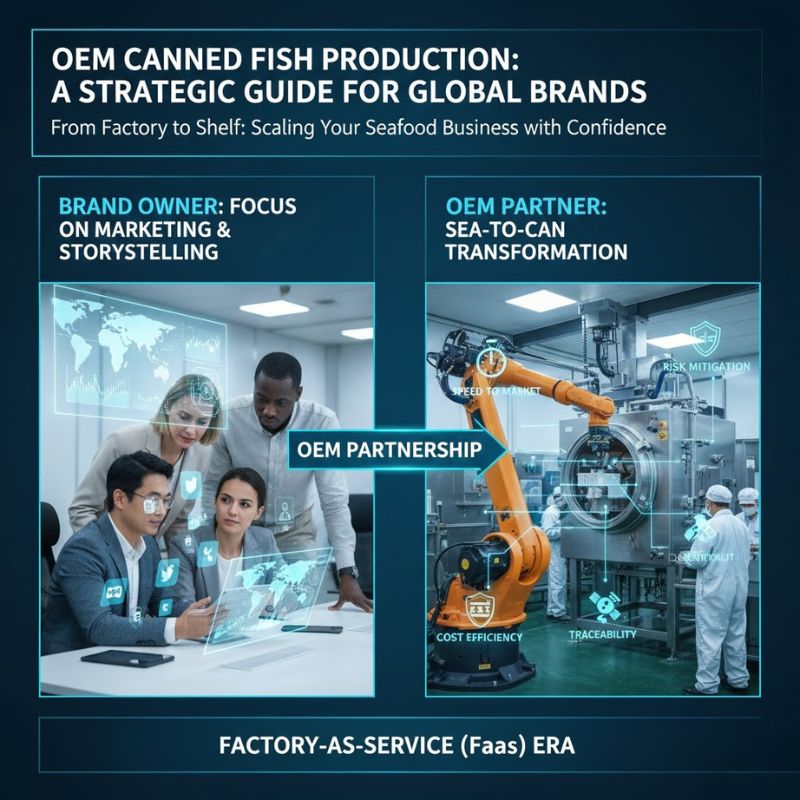
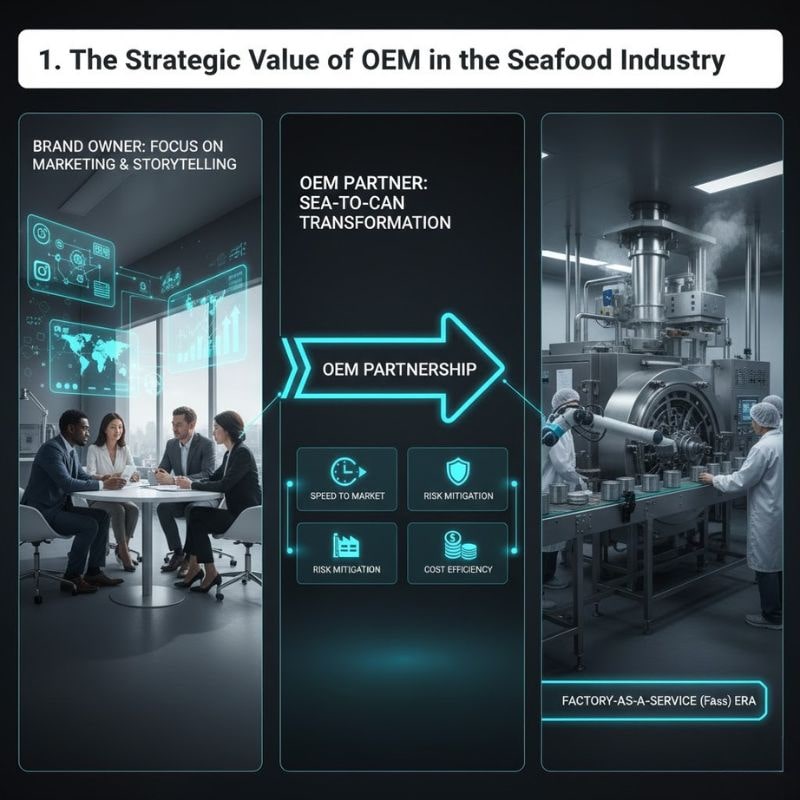
OEM canned fish production is more than just outsourcing; it is a collaborative model where the manufacturer acts as the technical backbone of your business. In this “Factory-as-a-Service” (FaaS) era, the brand owner focuses on marketing, brand storytelling, and distribution channels, while the OEM partner manages the “Sea-to-Can” transformation.
Why OEM is the Preferred Choice for Scalability:
- Speed to Market: Establishing a certified canning facility can take years. An OEM partner provides an immediate “Green Channel” to production.
- Risk Mitigation: The manufacturer assumes the responsibility for food safety, worker safety, and environmental compliance.
- Cost Efficiency: OEM partners benefit from economies of scale in raw material sourcing (fish, cans, oil) that a standalone brand could never achieve.
2. Technical Pillars: The Science Behind the Can
A premium OEM canned fish production line is a marvel of food engineering. Every step is designed to preserve the delicate omega-3 fatty acids and protein structure of the fish while ensuring absolute safety.
Advanced Thermal Processing (The Retort Phase)
The most critical technical element is the retort process. To achieve a shelf life of 3–5 years without artificial preservatives, the product must reach Commercial Sterility.
- The 121°C Standard: OEM factories utilize automated, PLC-controlled retorts that maintain a steady 121°C (250°F). This temperature is scientifically required to eliminate Clostridium botulinum spores.
- Thermal Validation: High-tier OEM partners conduct “Heat Penetration Studies” for every new recipe to ensure the heat reaches the center of the can (the cold spot) consistently.
The Art of Liquid Mediums and Recipe Engineering
Modern OEM production has moved beyond simple brine. Today, it is about culinary innovation.
- Vacuum Filling: Before the can is seamed, vacuum technology removes air pockets. This prevents lipid oxidation—the process that makes fish taste “fishy” or rancid over time.
- Custom Formulations: Brands can request bespoke media, such as extra virgin olive oil, organic tomato sauce, infusion with chili and herbs, or even ethnic-specific sauces like Teriyaki or Szechuan.
3. Navigating the “Passport” of Certifications
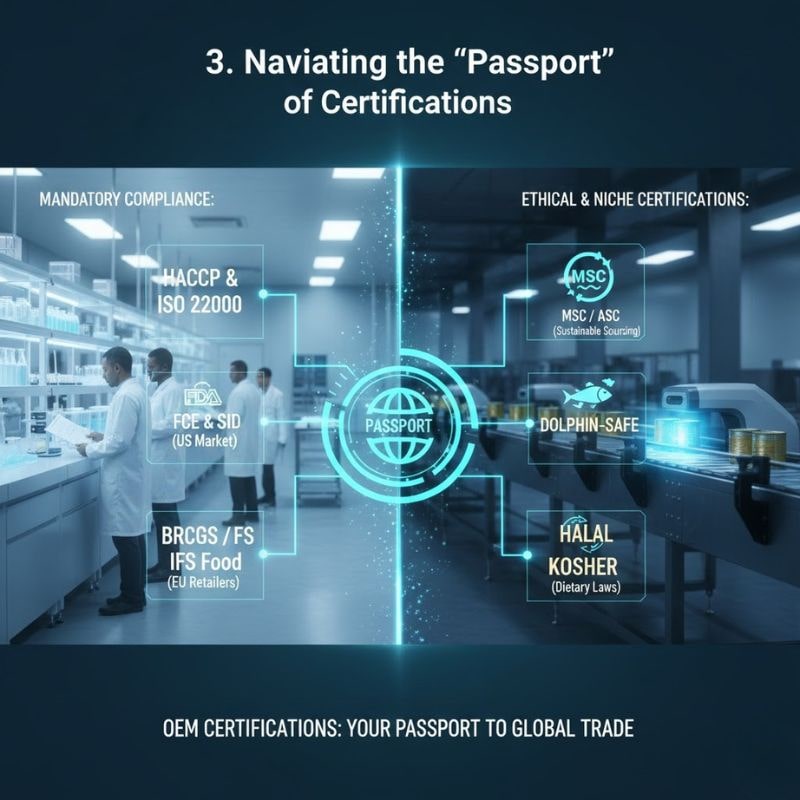
In the world of OEM canned fish production, certifications are your passport to global trade. Without them, your product will be rejected at the border. A professional OEM partner should hold a comprehensive portfolio of global standards.
Mandatory Compliance:
- HACCP & ISO 22000: The baseline for any international food production.
- FDA FCE & SID: For the US market, the factory must have a Food Canning Establishment (FCE) number, and every product must have a Submission Identifier (SID).
- BRCGS / IFS Food: These are the “Gold Standards” required by major European retailers like Tesco, Lidl, and Carrefour.
Ethical and Niche Certifications:
- Sustainable Sourcing (MSC/ASC): Proving that the fish was not overfished.
- Dolphin-Safe: Essential for tuna products in Western markets.
- Dietary Laws (Halal/Kosher): Opening doors to hundreds of millions of consumers in the Middle East and specialized communities globally.
4. The Anatomy of the OEM Workflow: From Concept to Container
Success in OEM canned fish production depends on a disciplined, multi-stage workflow.
Step 1: Specification & R&D
The brand defines the “Identity” of the product:
- Species: Tuna (Skipjack, Yellowfin), Mackerel, or Sardines.
- Texture: Solid, Chunk, or Flake.
- Packaging: Tinplate or Aluminum cans with Easy-Open Ends (EOE).
Step 2: Sampling and Sensory Evaluation
The OEM lab produces small batches. Professional tasters and the brand owner evaluate the organoleptic properties: appearance, texture, aroma, and saltiness. This is where the “Secret Sauce” is perfected.
Step 3: Regulatory Review and Label Design
OEM experts review the label artwork to ensure it complies with the destination country’s laws, including font sizes for Nutrition Facts, allergen declarations (e.g., “Contains: Fish”), and country-of-origin labeling.
Step 4: Mass Production and Seam Analysis
During production, the factory performs “Double Seam Analysis” every hour. Using digital micrometers, technicians ensure the lid is perfectly fused to the can body. A deviation of 0.01mm is enough to stop the entire line.
Step 5: The 14-Day Quarantine
Every batch produced must sit in a controlled warehouse for 14 days. This is the “Incubation Period” where samples are checked for gas production or microbial growth before the container is allowed to be loaded for export.
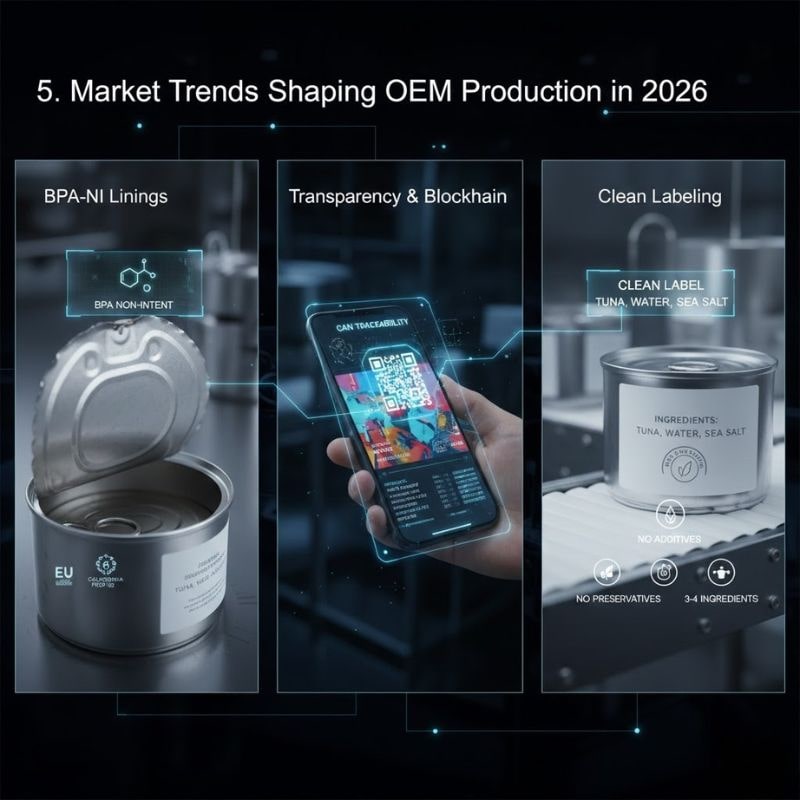
5. Market Trends Shaping OEM Production in 2026
The OEM landscape is being reshaped by three major trends:
- BPA-NI Linings: “BPA Non-Intent” linings are becoming the default requirement as consumers and regulators (like those in California and the EU) demand the removal of Bisphenol-A from food contact materials.
- Transparency & Blockchain: Leading OEM partners are integrating QR codes on cans that allow consumers to see exactly which vessel caught their fish.
- Clean Labeling: There is a massive move toward “Clean Labels”—products with only 3 or 4 ingredients (e.g., Tuna, Water, Sea Salt) and zero chemical additives.
6. Frequently Asked Questions (FAQ)
What is the typical Minimum Order Quantity (MOQ) for OEM canned fish production?
To optimize production efficiency and ensure cost-effectiveness for the brand owner, the standard MOQ is typically one 20ft container (approximately 1,100 to 1,500 cartons, depending on can size). However, for premium or specialized formulations, some factories offer flexible trial runs to help brands test market response before committing to full-scale volume.
Can I develop and use my own brand’s proprietary sauce recipe?
Absolutely. One of the core strengths of a premium OEM partner is Recipe Engineering. You can either provide your own formula or collaborate with our R&D team to create a bespoke flavor profile. To ensure your intellectual property is fully protected, we sign strict Non-Disclosure Agreements (NDAs) before any formulation details are shared.
How can I verify the quality and reliability of an OEM factory in Vietnam?
A reliable partner should be transparent about two things: Certifications and Track Record.
- Certifications: Ensure the factory holds third-party audited standards such as BRCGS (Grade A/AA), IFS, and US FDA registration.
- Experience: Look for a management team with over 15 years of industry expertise and a proven history of exporting to high-standard markets like the USA, EU, or Japan. Physical or virtual factory tours are also highly recommended.
Is there a practical difference between OEM and Private Label services?
While often used interchangeably, there is a slight strategic difference:
- OEM (Original Equipment Manufacturer): Focuses on customization. You define the specific fish grade, unique sauce recipes, and custom packaging requirements.
- Private Label: Typically refers to a faster “turnkey” solution where you place your branding on the factory’s existing, market-proven formulations. A versatile factory should be able to provide both, depending on your brand’s maturity and market strategy.
How does the factory ensure the “Drained Weight” meets international standards?
Precision is key. We utilize automated high-speed filling lines and computerized check-weighers. Every batch undergoes rigorous sampling to ensure the ratio of fish-to-liquid strictly adheres to the legal requirements of your destination market, preventing costly recalls and ensuring consumer satisfaction.
7. Conclusion: Choosing a Legacy, Not Just a Vendor
The choice of an OEM canned fish production partner is the single most important factor in your brand’s longevity. In an industry where one quality lapse can lead to a global recall, you need a partner that values safety over speed and precision over price.
A world-class OEM partner provides more than just machinery; they provide the peace of mind that every can opened by a consumer will be a testament to your brand’s commitment to quality.
- Inside a Modern Canned Fish Processing Factory: A Blueprint for Global Supply Chain Excellence
- Canned Fish Manufacturing Factory: The Technical Blueprint for Global Safety and Scalability
- Canned Fish Packaging Design Service: What Really Makes a Label Work
- Expert Guide: Large-Scale Canned Fish Manufacturing Factory
- Custom Canned Fish Production and Packaging Design: An Integrated OEM & Branding Approach
- Large-Scale Canned Fish Production and Supply: A Comprehensive Guide for Global Buyers
- Canned Fish Production and Processing Support Service for Global Brands
- The Strategic Guide to Canned Fish Packaging Services: Navigating Global Private Label Standards