In the global seafood industry, large-scale canned fish production and supply is a critical foundation for international brands, private-label programs, and food distributors operating across multiple export markets. This topic is not consumer-focused but reflects the needs of sourcing teams seeking manufacturing partners that can deliver consistent volume, regulatory compliance, and long-term supply reliability. As industry knowledge platforms like CannedFish.shop often highlight, large-scale canned fish supply extends far beyond processing capacity to include food safety systems, packaging performance, and export readiness. This article provides a practical, buyer-oriented overview of how large-scale canned fish production and supply systems work and what global buyers should evaluate before committing to long-term sourcing decisions.
1. What Does “Large-Scale Canned Fish Production and Supply” Really Mean?
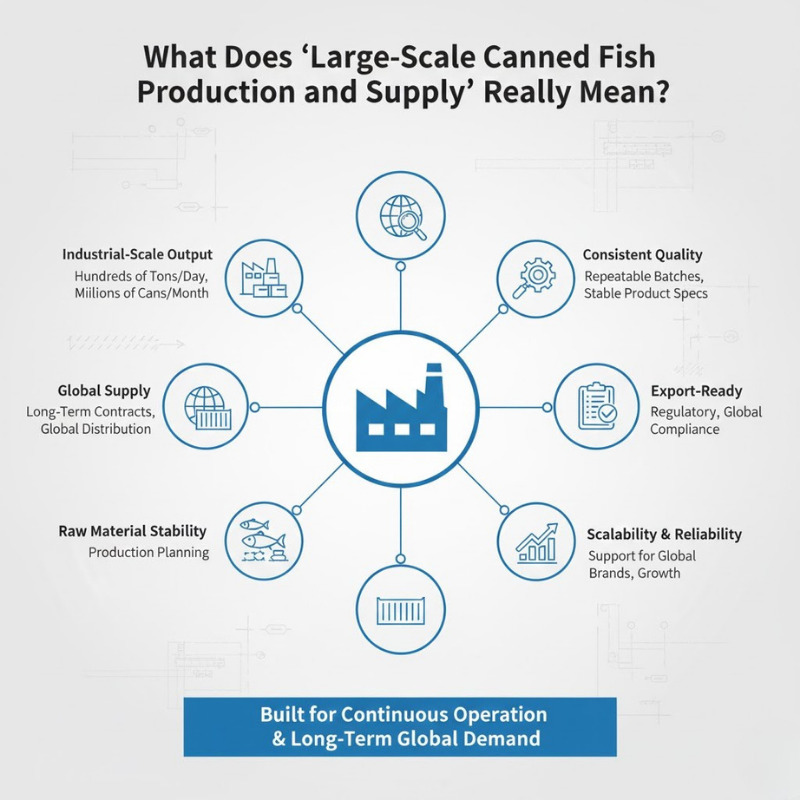
Large-scale canned fish production and supply refers to an industrial manufacturing capability designed to deliver high volumes of canned fish products with consistent quality and stable supply over time. It is not only about factory size, but about the ability to operate continuously and meet long-term demand from global buyers.
This model typically includes industrial-scale output (hundreds of tons per day or tens of millions of cans per month), repeatable production performance across multiple batches, and export-ready systems that comply with regulations in different markets. Just as important, large-scale supply requires strong raw material sourcing and production planning to support long-term contracts, not one-off or short-run orders. In practice, large-scale canned fish production and supply is built to serve global distribution networks rather than domestic or limited-volume programs.
2. Industrial Infrastructure Behind Large-Scale Production
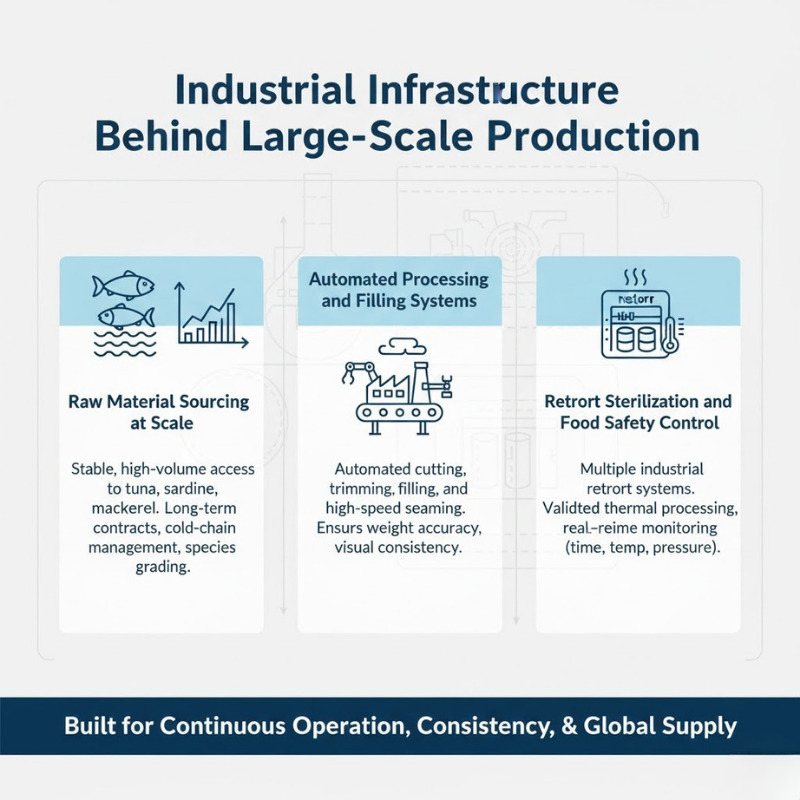
Raw Material Sourcing at Scale
At the foundation of large-scale canned fish production and supply is stable, high-volume access to raw materials such as tuna, sardine, mackerel, salmon, or anchovy. Without a reliable sourcing system, even the most advanced factory cannot sustain large-scale operations.
Key sourcing characteristics typically include long-term contracts with fishing fleets or approved suppliers, strict cold-chain management from landing to processing, and species grading and quality screening to ensure uniform raw material input. This stability helps large-scale canned fish production reduce supply disruptions, control cost fluctuations, and maintain consistent product quality across batches.
Automated Processing and Filling Systems
To deliver both volume and consistency, large-scale canned fish production and supply relies heavily on automated processing lines rather than manual handling.
Core production stages usually include mechanical cutting, trimming, and portion control, automated filling and liquid dosing systems, and high-speed seaming with vacuum control. Automation not only improves output capacity but also ensures weight accuracy, visual consistency, and line efficiency across millions of cans produced each month.
Retort Sterilization and Food Safety Control
Food safety is non-negotiable in large-scale canned fish production. All products must achieve commercial sterility through validated thermal processing.
At scale, this requires multiple industrial retort systems operating continuously, SKU-specific thermal process validation, and real-time monitoring of time, temperature, and pressure. Retort capacity, validation documentation, and process control are central pillars of any dependable large-scale canned fish supply operation serving international markets.
3. Supply Chain Integration and Export Readiness
Large-scale canned fish production and supply is inherently export-oriented. Beyond factory output, capable suppliers must operate fully integrated supply chain systems.
This includes batch traceability linking raw materials to finished goods, production planning across multiple SKUs and private-label brands, and complete export documentation such as health certificates, certificates of origin, and laboratory test reports. In addition, suppliers must coordinate container loading, shipping schedules, and destination-specific requirements.
Without strong supply chain integration, large-scale canned fish suppliers often face delays, regulatory issues, or inconsistent deliveries—risks that global buyers cannot afford.
4. Packaging and Labeling in Large-Scale Supply Programs
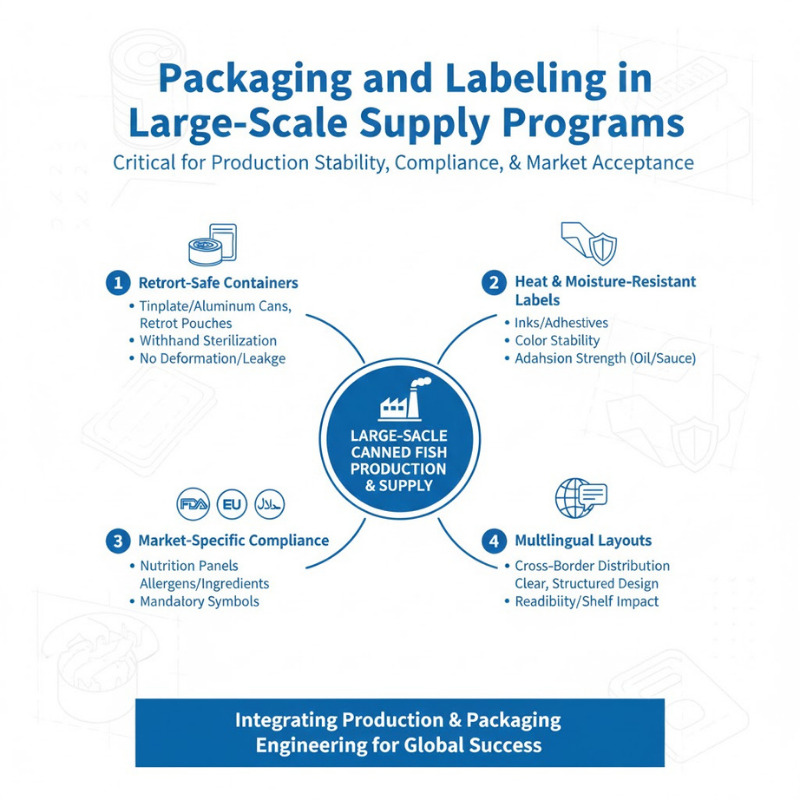
In large-scale canned fish production and supply, packaging is not just a visual element—it is a critical technical and commercial component that directly affects production stability, export compliance, and brand acceptance in target markets.
Key requirements include:
-
Retort-safe containers (tinplate cans, aluminum cans, retort pouches): Packaging must withstand high-temperature sterilization without deformation, leakage, or coating failure during continuous large-scale production.
-
Heat- and moisture-resistant labels and inks: Labels must remain intact and readable after retort processing, long-distance shipping, and extended shelf storage, especially for oil- or sauce-based products.
-
Market-specific labeling compliance (FDA, EU, ASEAN, Middle East): Packaging must support different regulatory formats, including nutrition panels, allergen statements, ingredient declarations, and mandatory symbols for each export market.
-
Multilingual layouts for cross-border distribution: Large-scale canned fish supply programs often serve multiple countries at once, requiring clear, well-structured multilingual packaging without compromising readability or shelf impact.
At scale, packaging decisions directly influence line efficiency, shelf-life performance, regulatory approval speed, and overall market acceptance, making early coordination between production and packaging teams essential.
5. Who Relies on Large-Scale Canned Fish Production and Supply?
This sourcing model is primarily used by buyers who require high-volume, repeatable, and export-ready canned fish supply rather than short-term or spot production.
Typical users include:
-
Importers supplying national or regional retail chains: These buyers need consistent product quality, stable pricing, and reliable delivery schedules to support long-term retail contracts.
-
Private-label buyers launching multi-market canned fish lines: Large-scale canned fish production and supply allows private-label programs to expand across regions while maintaining standardized product specifications.
-
Food distributors serving supermarkets and foodservice operators: Distributors depend on large-scale supply partners to ensure uninterrupted availability across multiple channels.
-
Brand owners scaling from regional to global distribution: As brands grow, large-scale production capability becomes essential to meet rising demand and regulatory complexity.
-
E-commerce brands requiring stable, high-volume fulfillment: Online channels require predictable inventory flow and uniform product presentation across fulfillment centers.
For all of these buyers, success in large-scale canned fish production and supply depends on predictability, regulatory compliance, and long-term supply reliability, not just manufacturing capacity alone.
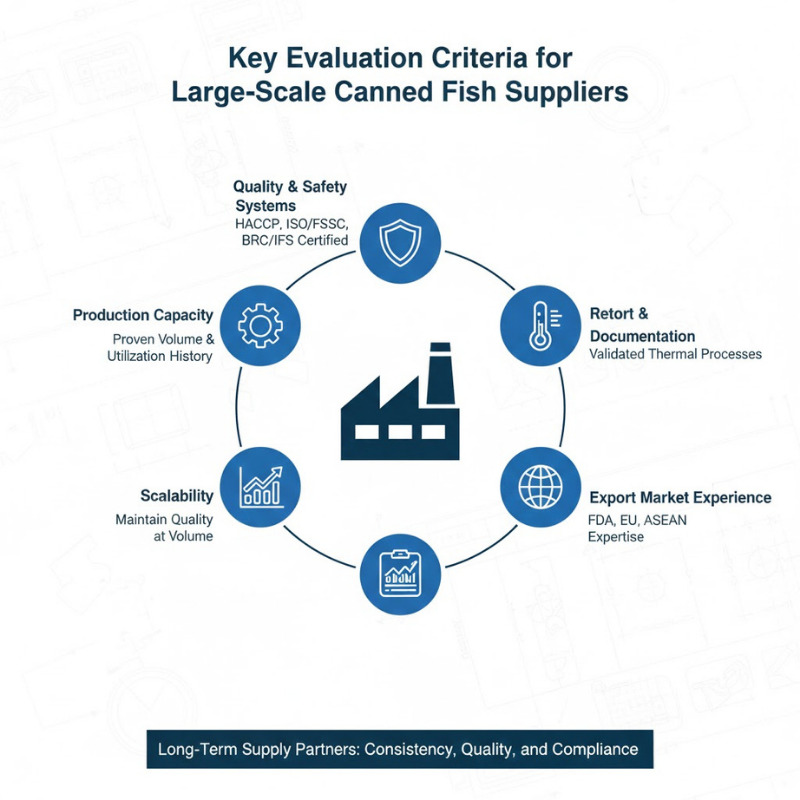
6. Key Evaluation Criteria for Large-Scale Canned Fish Suppliers
When selecting partners for large-scale canned fish production and supply, buyers should evaluate more than advertised capacity. The focus should be on whether the supplier can deliver consistent volume, stable quality, and regulatory compliance over time.
Key evaluation criteria include:
-
Proven production capacity and utilization history: Suppliers should demonstrate real operating capacity with stable output records, not just theoretical maximum volumes.
-
Quality and food safety systems (HACCP, ISO/FSSC, BRC/IFS): Certified systems indicate structured risk control, process consistency, and readiness for international audits.
-
Retort validation and documentation capability: Reliable suppliers maintain validated thermal processes and complete records for each SKU to support food safety and buyer audits.
-
Experience with target export markets: Familiarity with FDA, EU, ASEAN, or Middle East regulations reduces approval delays and compliance risks.
-
Ability to scale volume without quality degradation: True large-scale canned fish production and supply requires maintaining taste, texture, and appearance as volumes increase.
The most capable suppliers operate as long-term supply partners, supporting planning, forecasting, and risk management—not merely executing short-term contracts.
Buyer Insights: Common Questions About Large-Scale Canned Fish Production and Supply
What minimum order volumes typically define “large-scale” canned fish supply?
Large-scale canned fish production usually starts at container-level volumes with ongoing supply programs, rather than single pilot or trial orders.
Can large-scale suppliers still support private-label customization?
Yes. Many large-scale canned fish suppliers offer private-label options, as long as customization aligns with standardized production and packaging systems.
How do large-scale suppliers manage price stability amid raw material volatility?
Established suppliers rely on long-term sourcing agreements, inventory buffering, and production forecasting to reduce short-term price fluctuations.
Is large-scale canned fish production suitable for premium products?
Yes. With the right formulation control, packaging formats, and QA systems, large-scale supply can support premium positioning as well as mainstream products.
What risks should buyers watch for when sourcing large-scale canned fish supply?
Key risks include overstated capacity, weak traceability, limited export compliance knowledge, and poor coordination between production and logistics teams.
Large-scale canned fish production and supply is not simply about manufacturing volume—it is a fully integrated system combining raw material sourcing, industrial processing, food safety control, packaging, and global logistics. For importers, private-label buyers, and international brands, understanding how these systems function—and how to evaluate capable large-scale suppliers—helps minimize operational risk while supporting stable, long-term growth in the global canned fish market.
Read More:
- OEM Canned Fish Production: The Definitive Strategic Guide for Global Seafood Brands
- Inside a Modern Canned Fish Processing Factory: A Blueprint for Global Supply Chain Excellence
- Canned Fish Packaging Design Service: What Really Makes a Label Work
- Canned Fish Manufacturing Factory: The Technical Blueprint for Global Safety and Scalability
- Custom Canned Fish Production and Packaging Design: An Integrated OEM & Branding Approach
- Canned Fish Production and Processing Support Service for Global Brands
- The Strategic Guide to Canned Fish Packaging Services: Navigating Global Private Label Standards