In today’s global seafood market, custom canned fish production and packaging design can no longer be treated as separate workflows. Brands that succeed at scale understand that product formulation, industrial manufacturing, and packaging design must function as a single integrated system.For importers, private-label brands, retailers, and food distributors, the ability to balance manufacturing reliability with market-driven packaging design determines not only cost efficiency, but also compliance, shelf performance, and long-term brand value.
This article by Cannedfish.shop provides an in-depth look at how custom canned fish production and packaging design work together—from factory floor to global retail shelves.
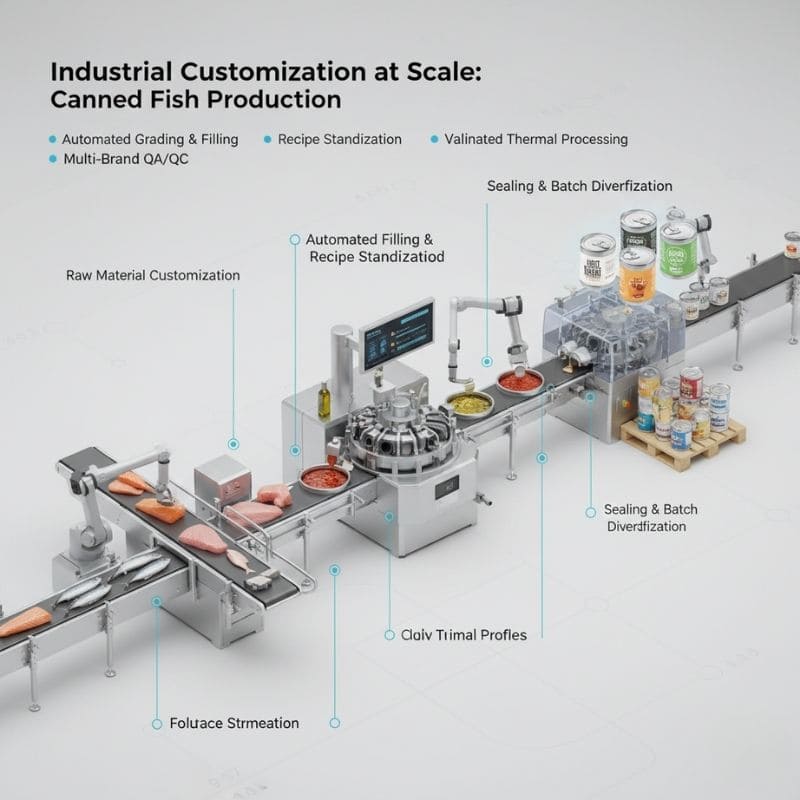
1. Custom Canned Fish Production: Industrial Customization at Scale
Custom canned fish production refers to OEM and ODM manufacturing models that allow brands to define product specifications while relying on industrial-scale processing systems.
Typical customization elements include:
-
Fish species selection (tuna, sardine, mackerel, salmon, anchovy)
-
Cut formats (solid, chunk, flakes)
-
Packing media (oil, brine, tomato-based sauces, chili, flavored oils)
-
Nutritional profiles (low sodium, clean-label, high-protein)
-
Portion sizes and container dimensions
-
Target-market regulatory requirements
From a production standpoint, customization must be repeatable and stable at high volume. This requires factories to operate with:
-
Automated grading, cutting, and filling systems
-
Recipe standardization across large batch sizes
-
Validated thermal processing for each SKU
-
Quality systems capable of handling multiple brands simultaneously
Without this infrastructure, customization becomes inconsistent, leading to quality deviation and regulatory risk.
2. Packaging Design as an Operational Component of Production
In custom canned fish production, packaging design is an operational decision, not a cosmetic one.
Canned fish packaging must perform under:
-
High-temperature retort sterilization
-
Pressure and moisture during processing
-
Long-distance sea freight and container stacking
-
Extended shelf-life conditions
As a result, packaging design must be developed in parallel with product formulation and production planning.
Key functional requirements of packaging design include:
-
Compatibility with retort heat and pressure
-
Long-term corrosion and oxygen barrier performance
-
Resistance to ink fading, delamination, and adhesive failure
-
Structural durability during export logistics
A visually appealing design that fails technically can cause production downtime, batch rejection, or costly relabeling—making packaging design a risk-control mechanism within large-scale canned fish manufacturing.
3. The Production–Design Interface: Where Success Is Determined
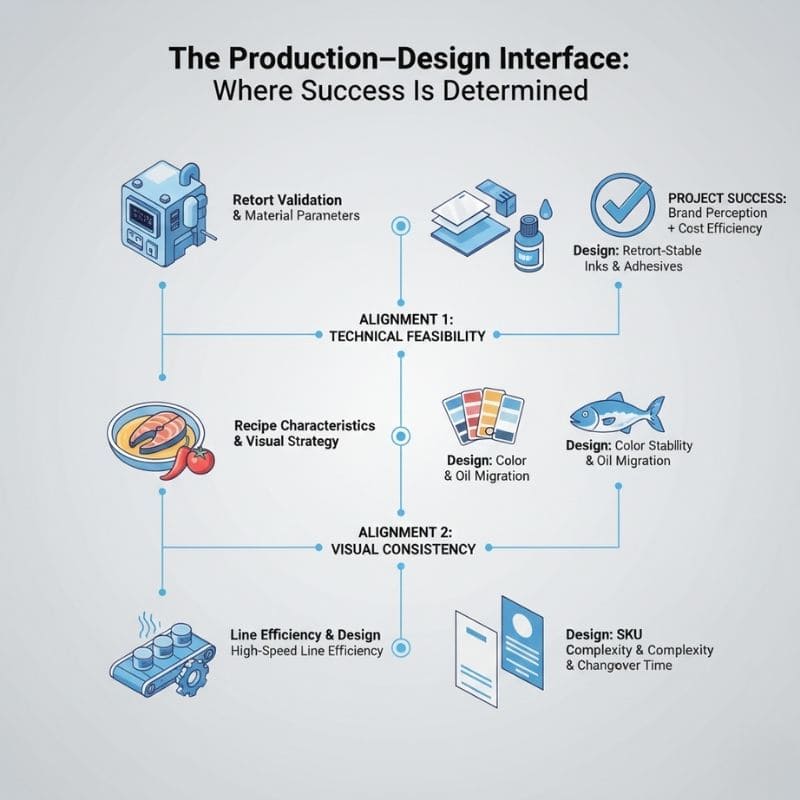
The success of custom canned fish projects is largely decided at the point where production requirements meet packaging design decisions. At this stage, technical feasibility, efficiency, and brand goals must be aligned.
-
Retort Validation and Material Engineering: Production teams define sterilization temperature, pressure, and time, while packaging design teams must select materials—such as can substrates, internal coatings, inks, and adhesives—that remain stable, food-safe, and visually consistent under high thermal stress.
-
Recipe Characteristics and Visual Strategy: Different formulations behave differently during retort processing. Oil-based, acidic, or spicy recipes can affect color appearance, oil migration, and surface staining. Packaging design must anticipate these changes to ensure long-term visual consistency on the shelf.
-
Line Efficiency and Design Complexity: Highly complex packaging designs, frequent SKU variations, or multiple label versions increase line changeovers and slow down production. Successful projects balance clear visual differentiation with designs that are efficient to run on high-speed production lines.
-
Cost Structure vs. Brand Perception: Production decisions determine unit cost and scalability, while packaging design shapes how consumers perceive value. In many cases, premium positioning is achieved not through complex recipes, but through clean, well-structured, and confident packaging design.
4. Retort-Safe Packaging Formats in Custom Canned Fish Production
Modern custom canned fish production supports several retort-safe packaging formats. Each format comes with its own technical, design, and operational considerations that must be addressed early in the development process.
-
Tinplate Cans (Round, Oval, Easy-Open): The most widely used packaging format due to proven durability, excellent barrier properties, and full compatibility with high-speed automated production lines. Packaging design typically focuses on clear product communication, strong shelf visibility, and regulatory readability.
-
Aluminum Cans with Food-Grade Coatings: Aluminum cans offer weight reduction and corrosion resistance when paired with properly selected internal coatings. Packaging design must consider coating performance, surface stability, and visual consistency after exposure to retort heat and pressure.
-
Retort Pouches: Retort pouches support lighter logistics, lower transportation costs, and a more modern shelf appearance. Packaging design priorities include seal strength, laminate structure, pouch shape stability, and validated heat penetration during sterilization.
-
Specialty and Composite Containers: Formats such as glass jars, composite cans, or custom-shaped containers are often used for premium or niche canned fish products. These options allow greater design flexibility and brand differentiation but introduce higher material costs, slower production speeds, and stricter handling requirements.
-
Design Validation Across All Formats: Regardless of packaging type, all designs must be tested under real production conditions. This ensures resistance to ink migration, label peeling, coating failure, or container deformation during retort processing and long-term storage.
5. Packaging Design Trends Aligned With Production Reality
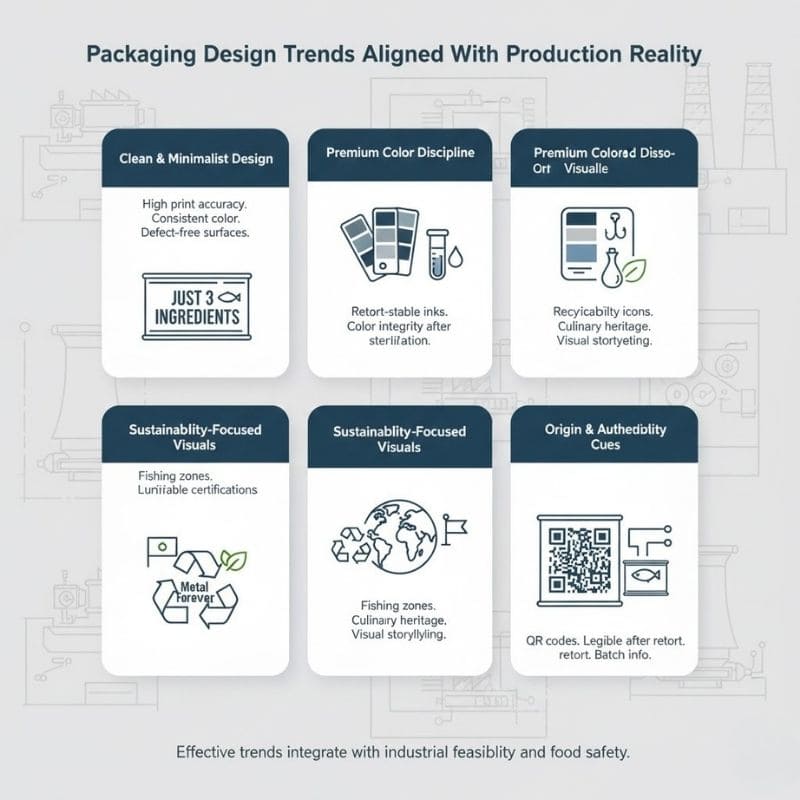
Packaging design trends strongly influence consumer perception, but in custom canned fish production, trends must always be evaluated through the lens of industrial feasibility, food safety, and scalability. Design decisions that work in theory but fail under retort conditions or mass production often lead to costly revisions and delayed market entry.
The most effective packaging trends today are those that integrate seamlessly with large-scale production systems.
Clean and Minimalist Design
Minimalist layouts with clear hierarchy, simplified graphics, and reduced visual clutter improve shelf readability and regulatory clarity across international markets. From a production standpoint, this trend demands high print accuracy, consistent color control, and defect-free surfaces, as even small imperfections become more visible on clean designs.
Premium Color Discipline
Muted color palettes, controlled contrast, and restrained typography are increasingly used to signal quality and trust. However, in canned fish production, these designs require retort-stable inks and coatings that maintain color integrity after high-temperature sterilization, especially for oil-packed and sauce-based products.
Sustainability-Focused Visual Communication
Environmental messaging has become a core design element rather than a supporting claim. Recyclability icons, responsible sourcing statements, and sustainability certifications must be fact-based and verifiable, aligning with actual production practices and third-party audits to avoid compliance or reputational risks.
Origin and Authenticity Cues
Packaging that highlights fishing zones, processing origin, or culinary heritage helps build credibility and emotional connection. This visual storytelling enhances brand value without increasing formulation complexity, making it highly compatible with scalable custom canned fish production models.
Digital Traceability and Smart Packaging Elements
QR codes and digital access points are increasingly embedded into packaging design to provide traceability, certification details, and brand storytelling. These elements must remain fully legible after retort sterilization and throughout shelf life, requiring early coordination between design, packaging materials, and production testing.
6. Regulatory and Export Compliance Built Into Packaging Design
In custom canned fish production, regulatory compliance is not handled by production alone—it must be built directly into packaging design from the start. Because most canned fish programs are export-driven, even small labeling or design errors can delay shipments, trigger relabeling, or block market entry entirely.
From the production side, factories are responsible for:
-
Food safety validation and thermal processing records
-
Accurate formulation and ingredient control
-
Batch-level traceability and production documentation
Packaging design must translate these technical requirements into market-ready, compliant packaging, supporting:
-
FDA, EU, and regional labeling regulations
-
Clear ingredient lists and allergen declarations
-
Market-specific nutrition panels and formatting rules
-
Batch codes, production dates, and QR-based traceability systems
-
Correct placement and usage of certification logos (MSC, ASC, Halal, Kosher, etc.)
When compliance requirements are integrated early into packaging design, brands benefit from:
-
Faster regulatory approval
-
Reduced rework and relabeling costs
-
Smoother coordination between factory, importer, and authorities
In large-scale custom canned fish production, compliance-driven design is not a constraint—it is a critical efficiency tool.
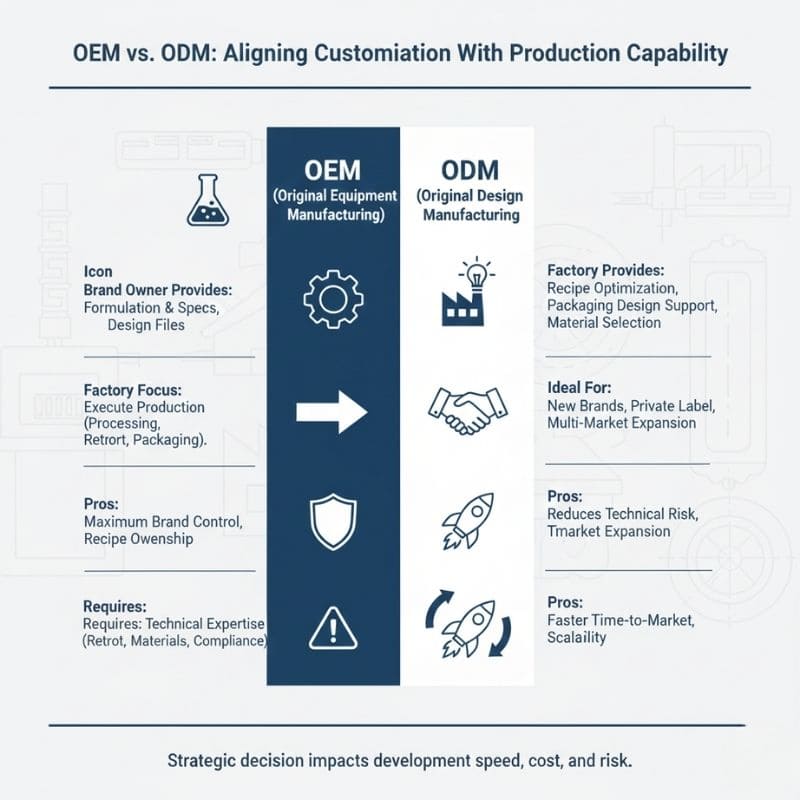
7. OEM vs. ODM: Aligning Customization With Production Capability in Custom Canned Fish Production
Choosing between OEM and ODM models is a critical decision in custom canned fish production and packaging design, as it directly impacts development speed, technical risk, cost control, and brand flexibility.
OEM (Original Equipment Manufacturing) in Custom Canned Fish Production
Under an OEM custom canned fish production model, the brand owner is responsible for providing:
-
Finished product formulation and specifications
-
Complete packaging design, artwork, and labeling files
The manufacturing factory focuses on executing production strictly according to provided specifications, including processing, retort sterilization, and packaging.
This approach offers:
-
Maximum brand and design control
-
Clear ownership of recipes and visual identity
However, OEM requires the brand to possess strong technical expertise in:
-
Retort processing and thermal validation
-
Packaging material compatibility
-
Regulatory and export compliance across target markets
Without this knowledge, OEM custom canned fish production may increase development risk and time-to-market.
ODM (Original Design Manufacturing) for Custom Canned Fish Production and Packaging Design
In an ODM custom canned fish production model, the factory plays an active role in both product development and packaging design support.
Factory capabilities typically include:
-
Product formulation and recipe optimization for large-scale production
-
Selection of retort-safe packaging structures and materials
-
Packaging design adaptation based on export regulations and market preferences
ODM is often the preferred model for:
-
New brands entering the canned fish category
-
Private-label canned fish programs
-
Brands expanding into multiple international markets
By leveraging factory expertise, ODM custom canned fish production and packaging design:
-
Reduces technical and compliance risk
-
Shortens development and approval timelines
-
Improves scalability and production consistency
Custom canned fish production and packaging design must be balanced, not prioritized separately. Manufacturing excellence ensures safety, consistency, and scalability. Packaging design ensures market relevance, differentiation, and regulatory clarity. Brands that integrate both from the beginning build products that perform not only on the factory line—but also on global retail shelves.
Read More:
- OEM Canned Fish Production: The Definitive Strategic Guide for Global Seafood Brands
- Inside a Modern Canned Fish Processing Factory: A Blueprint for Global Supply Chain Excellence
- Canned Fish Packaging Design Service: What Really Makes a Label Work
- Canned Fish Manufacturing Factory: The Technical Blueprint for Global Safety and Scalability
- Expert Guide: Large-Scale Canned Fish Manufacturing Factory
- Large-Scale Canned Fish Production and Supply: A Comprehensive Guide for Global Buyers
- Canned Fish Production and Processing Support Service for Global Brands
- The Strategic Guide to Canned Fish Packaging Services: Navigating Global Private Label Standards