Have you ever wondered why certain canned fish brands don’t just catch your eye—but compel you to pick them up? That moment is never accidental. In the global seafood industry, a specialized canned fish packaging design service is the invisible force that transforms a cold steel container into a credible, emotional, and legally compliant brand experience. For brand owners, the can is more than packaging—it is a silent brand ambassador that speaks when no salesperson is present. Whether you are a small-batch sardine producer or a multinational tuna exporter, your packaging must perform three demanding roles simultaneously: withstand a 121°C retort sterilization process, pass the scrutiny of international customs authorities, and win consumer trust in under three seconds. This article by Cannedfish.shop explores how professional packaging design achieves all three—without compromise.
1. Designing Appetite Before Contact: The Psychology of Shelf Impact
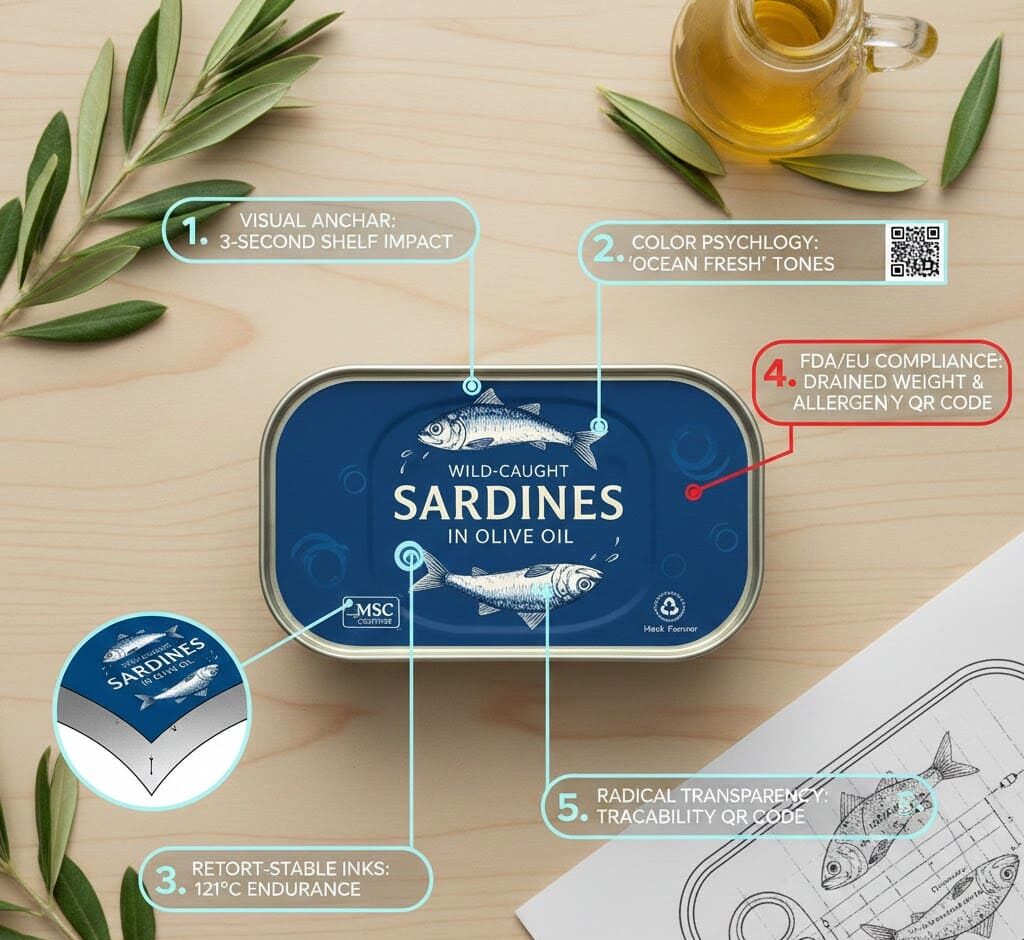
In canned seafood retail, the first interaction with the consumer is purely visual. No scent, no texture, no tasting—only sight. A professional canned fish packaging design service uses neuro-visual principles to transform a sealed metal container into something that feels fresh, desirable, and trustworthy.
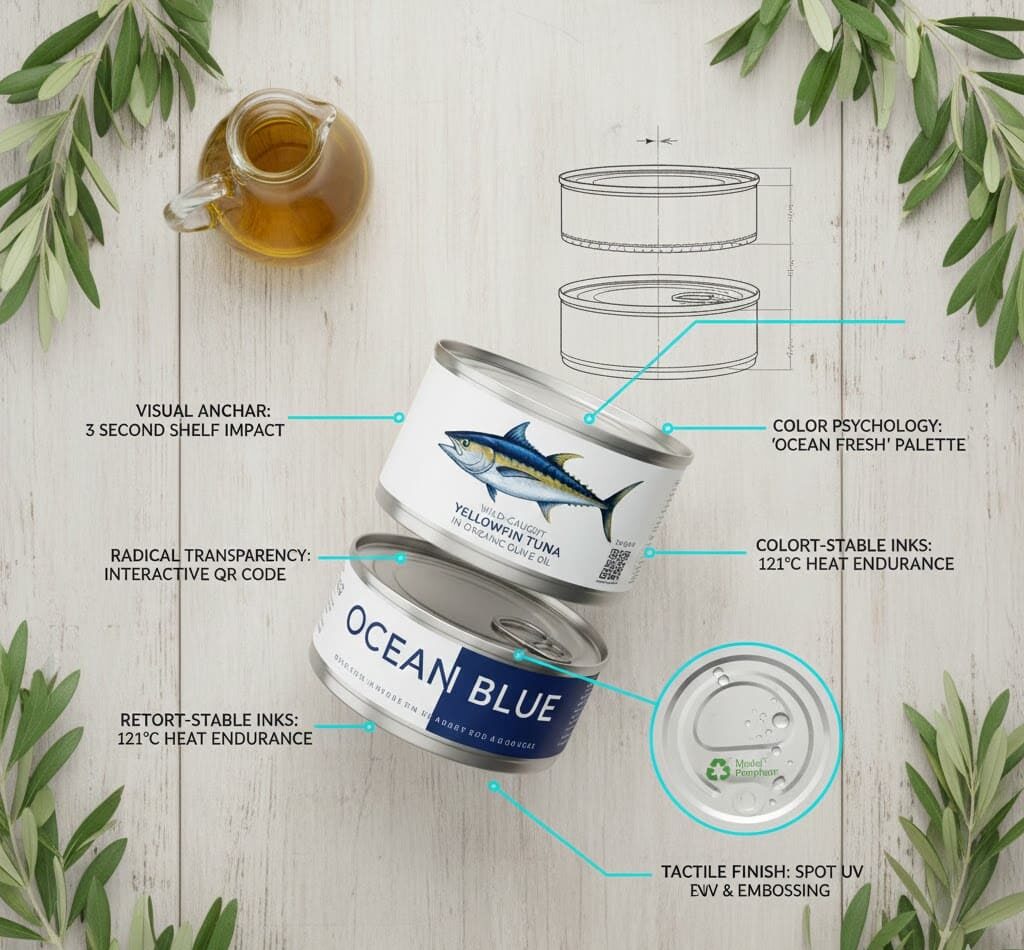
The “3-Second Shelf Rule”
Multiple retail studies show that consumers typically decide whether to consider a product within three seconds of seeing it on the shelf. High-performing canned fish packaging is therefore designed around visual hierarchy, not decoration.
Effective designs rely on:
-
Strong focal points (hero imagery or illustration)
-
Clear species identification
-
Immediate quality cues (origin, preparation method, oil type)
Whether through high-resolution macro food photography or heritage-style illustration, the goal is differentiation—especially in aisles dominated by price-driven, visually crowded competitors.
Color as an Informational Signal
In canned fish packaging, color functions as a category language, not an artistic choice.
-
Deep blues, silvers, and metallic tones signal ocean freshness and species integrity.
-
Earthy neutrals, kraft textures, and charcoal palettes often position products as artisanal, wood-smoked, or hand-packed.
-
Controlled accent colors help distinguish product variants (e.g., olive oil vs. brine) without fragmenting brand identity.
Professional services understand how color perception changes under supermarket lighting and on reflective metal surfaces—something digital mockups alone cannot predict.
Perceived Quality Through Surface Finishes
Beyond visuals, packaging design also influences how consumers feel about the product—even before touching it.
-
Matte varnishes reduce glare and increase readability.
-
Spot UV highlights can subtly mimic oil sheen or moisture, reinforcing freshness cues.
-
Controlled contrast enhances legibility while maintaining premium restraint.
These are not aesthetic trends; they are tactile perception strategies rooted in consumer psychology.
2. Retort-Proof Design: Where Graphic Design Meets Engineering
Unlike most consumer packaging, canned fish labels must survive retort sterilization—a process involving temperatures of approximately 121°C (250°F) under high pressure for extended periods.
This transforms packaging design into a technical discipline, not a purely creative one.
Materials and Ink Systems
Professional canned seafood packaging design services specify:
-
Heat-stable inorganic pigments
-
Retort-resistant adhesives to prevent edge lift or delamination
-
Protective coatings to avoid ink burn, discoloration, or odor migration
Designs created without this technical knowledge may look correct on screen—but fail during sterilization, leading to costly waste or recalls.
Curved Can Distortion Management
Metal cans are rarely flat. Round, oval, and club cans distort artwork when labels are applied.
Specialized designers use Distortion Grid Mapping (DGM) to pre-adjust layouts digitally, ensuring that typography, logos, and icons appear visually balanced once wrapped around the can.
This step is critical for brand consistency at scale—especially in export markets.
Safety Zones and Hermetic Integrity
Experienced packaging designers respect technical quiet zones, typically 3–5 mm from the double seam. This prevents ink interference with the hermetic seal, protecting food safety and shelf life.
These invisible design decisions often determine whether a product passes or fails quality audits.
3. Packaging as a Legal Document: Compliance Across Borders
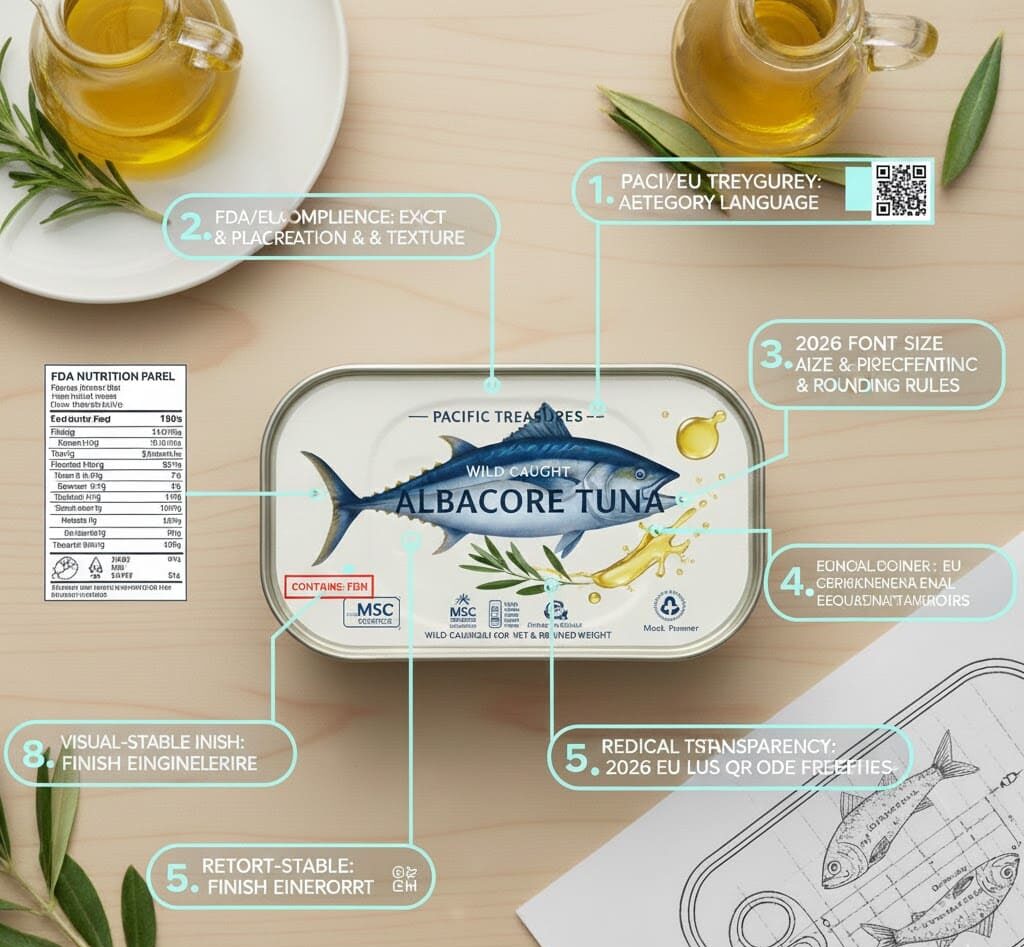
In international seafood trade, packaging functions as a legal passport. A single labeling error can delay shipments, trigger relabeling costs, or result in rejected containers at customs.
A professional canned fish packaging design service integrates regulatory compliance from the earliest design stage.
Regulatory Authorities and Label Structure
Agencies such as:
-
FDA (United States)
-
EFSA (European Union)
mandate strict rules for:
-
Net and drained weight declarations
-
Allergen emphasis
-
Minimum font sizes and contrast ratios
-
Ingredient order and naming conventions
Designers must understand not just what information is required, but how it must be presented.
Nutrition Labeling Complexity (2026 Context)
Modern nutrition panels require:
-
Updated rounding rules
-
Region-specific daily value references
-
Multilingual formatting for export SKUs
Professional services ensure scientific accuracy while maintaining clarity and visual balance.
Traceability as Trust Infrastructure
Mandatory elements—such as FAO catch zones, batch codes, and certification logos (MSC, ASC)—can be transformed from compliance burdens into visible trust signals when integrated correctly into the design system.
4. Sustainability Communication Through Packaging
By 2026, sustainability is no longer optional—it is expected. Packaging is often the primary channel through which brands communicate ethical commitments.
Clean Label Design Language
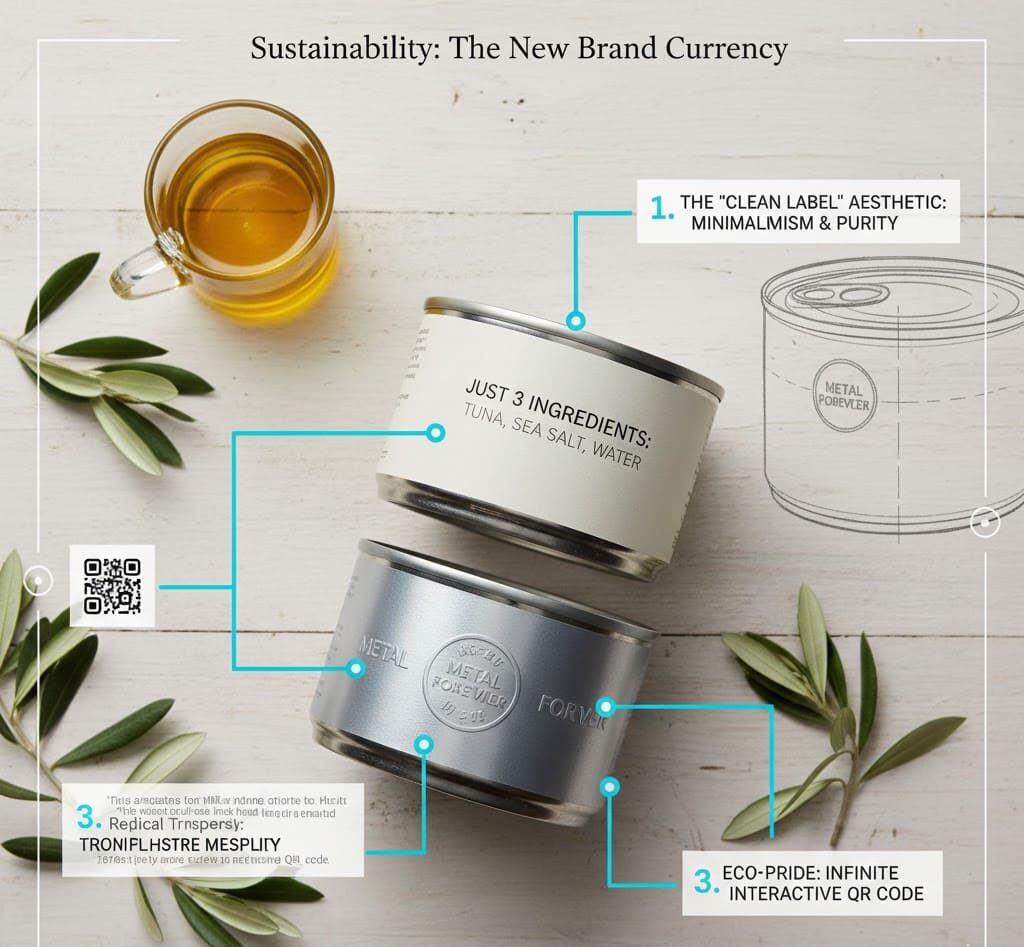
Minimalist layouts with restrained typography reinforce transparency. Highlighting short ingredient lists (e.g., “Fish · Salt · Water”) reduces consumer skepticism and aligns with clean-label expectations.
Digital Transparency via QR Codes
Interactive QR codes allow consumers to access:
-
Catch vessel data
-
Harvest dates
-
Processing locations
This turns traceability into a value-added experience rather than hidden compliance data.
Circular Economy Messaging
Metal’s infinite recyclability is increasingly emphasized through standardized icons and concise messaging. When placed strategically, these elements resonate strongly with Gen Z and Millennial buyers who value environmental accountability.
5. How to Choose the Right Canned Fish Packaging Design Service
Not all packaging design services are equipped to handle canned seafood. Choosing the wrong partner can result in failed retort tests, regulatory issues, or packaging that looks appealing on screen but underperforms in real retail environments. The following criteria help brand owners evaluate whether a design service truly specializes in canned fish packaging—or merely offers general graphic design.
Proven Experience With Retort Packaging
The first and most critical criterion is hands-on experience with retort-processed products.
A qualified canned fish packaging design service should be able to demonstrate:
-
Past projects that have successfully passed 121°C retort sterilization
-
Knowledge of ink behavior, color shift, and adhesive performance under heat and pressure
-
Clear understanding of can seam safety zones and label tolerance limits
Designers without retort experience often underestimate how aggressively heat and pressure affect materials—leading to label distortion, fading, or delamination after production.
Key indicator: Ask whether the service designs specifically for post-retort appearance, not pre-retort mockups.
Technical Knowledge of Metal Printing & Substrates
Canned seafood packaging is typically printed via lithography on tinplate or aluminum, which behaves very differently from paper, plastic, or digital media.
A specialized service should understand:
-
Ink trapping and dot gain on metallic substrates
-
Reflectivity and luminosity shifts on bare vs. white-coated metal
-
How varnishes and coatings interact with both ink and metal during sterilization
Without this knowledge, even well-designed layouts can lose contrast, legibility, or brand consistency in final production.
Regulatory & Market-Specific Competence
Packaging design for canned fish is inseparable from food labeling law.
A reliable design service should demonstrate familiarity with:
-
FDA and EFSA labeling frameworks
-
Nutrition panel formatting and regional variations
-
Allergen declaration rules and font-size compliance
-
Multilingual layouts for export markets
More importantly, they should design with compliance in mind from the start, not attempt to retrofit legal information into a finished layout.
Warning sign: If compliance is treated as “content you provide later,” the risk of errors increases significantly.
Ability to Handle Regional Adaptations at Scale
Brands operating in multiple markets rarely use a single universal label.
A competent canned fish packaging design service should offer:
-
Structured systems for US, EU, and Asia-market adaptations
-
Version control for SKUs, languages, and regulatory updates
-
Consistent brand DNA across all regional variants
This capability becomes critical as product lines expand and regulatory requirements evolve.
Collaboration With Printers and Can Manufacturers
Packaging design does not end at the design file. The best services understand the entire production ecosystem.
Look for partners who:
-
Communicate directly with lithographic printers when needed
-
Adjust artwork based on press proofs or test runs
-
Understand can manufacturer tolerances and label application constraints
This cross-functional awareness significantly reduces costly revisions and production delays.
Sustainability & Traceability Integration
Modern canned fish packaging must communicate more than product information—it must convey values.
A qualified service should be able to:
-
Integrate sustainability certifications (MSC, ASC, Dolphin Safe) correctly
-
Design clean-label layouts that enhance ingredient transparency
-
Implement QR-based traceability without cluttering the label
Sustainability elements should feel intentional and credible, not decorative or tokenistic.
Process Transparency & Risk Management
Finally, a professional canned fish packaging design service operates with a clear, structured workflow.
This includes:
-
Defined stages (concept → compliance check → technical validation → prepress)
-
Risk identification before production
-
Documentation that supports audits, reprints, or regulatory reviews
Well-documented processes protect both the brand owner and the manufacturer in the long term.
6. Common Questions When Choosing a Packaging Design Service
Why not use a general freelance designer?
Canned fish packaging requires knowledge of lithographic printing on tinplate, ink behavior on metal, and retort conditions. Without this expertise, designs risk color shifts, peeling, or regulatory non-compliance.
What does “BPA-NI” really mean?
BPA-NI (BPA Non-Intent) indicates that the can liner is produced without intentionally added Bisphenol A. Beyond safety, it functions as a strong reassurance signal for health-conscious consumers.
Can one label design work globally?
Rarely. FDA and EFSA requirements differ significantly. Professional services typically develop regional adaptations—preserving brand identity while ensuring full legal compliance per market.
Packaging is the final, most critical bridge between a manufacturing facility and the consumer’s dinner table. In the competitive landscape of 2026, a specialized canned fish packaging design service is no longer a luxury—it is a strategic necessity. Investing in expert design means going beyond “art.” It is about securing a tool that guarantees global compliance, survives industrial heat, and speaks the silent language of consumer trust. When technical precision meets creative storytelling, a simple tin of fish is transformed into a shelf-ready masterpiece—one that doesn’t just sit in a store, but finds its way into homes worldwide.
Read More:
- OEM Canned Fish Production: The Definitive Strategic Guide for Global Seafood Brands
- Inside a Modern Canned Fish Processing Factory: A Blueprint for Global Supply Chain Excellence
- Expert Guide: Large-Scale Canned Fish Manufacturing Factory
- Custom Canned Fish Production and Packaging Design: An Integrated OEM & Branding Approach
- Large-Scale Canned Fish Production and Supply: A Comprehensive Guide for Global Buyers
- Canned Fish Production and Processing Support Service for Global Brands
- The Strategic Guide to Canned Fish Packaging Services: Navigating Global Private Label Standards